
Choosing a countertop material is only half the project. The other half is choosing who templates, fabricates, and installs it, and that decision affects the finished product just as much as whether you pick granite or quartz. Homeowners searching for kitchen countertop contractors in San Diego are often comparing very different types of businesses without realizing it, from big-box retailers who subcontract the work out, to dedicated stone fabricators who handle the entire process in-house.
| QUICK ANSWER A kitchen countertop contractor in San Diego should handle templating, fabrication, and installation as one continuous process, ideally in-house rather than farmed out to multiple subcontractors. Ask how they template your space, where fabrication happens, and how they plan seam placement before you sign anything. Those three answers tell you more about the finished result than any material brochure will. |
What a Kitchen Countertop Contractor Actually Does
The term “countertop contractor” covers a wide range of businesses. Some are general contractors who subcontract stone work out to a third-party fabricator. Others, like Ghiloni Granite and Tile, are stone fabricators first, meaning the templating, cutting, edging, and installation all happen under one roof. That distinction matters because every handoff between businesses is a place where measurements, communication, or accountability can slip.
| Stone Fabricator | General Contractor (subcontracted) | |
| Templating | Done by the team that will fabricate your slab | Often outsourced to a separate measuring service |
| Fabrication | In-house shop, direct quality control | Sent to a third-party fabricator you may never meet |
| Installation | Same team that cut the slab installs it | A separate install crew unfamiliar with the fabrication |
| Accountability | One point of contact for the whole project | Issues can get passed between multiple businesses |
The Process, Step by Step
Regardless of who you hire, a legitimate countertop installation follows a consistent sequence. Understanding it helps you know what questions to ask at each stage.
Each step depends on the one before it, which is why continuity between steps matters more than speed.
The templating step deserves particular attention. Digital laser templating has become the standard for accurate measurements, capturing the exact dimensions of your cabinets, walls, and any out-of-square corners, which are more common in older San Diego homes than most people expect. A contractor who skips a dedicated templating visit and works from rough measurements alone is taking on risk that eventually lands on the homeowner in the form of a poor-fitting slab.
Where Seams End Up, and Why It Matters
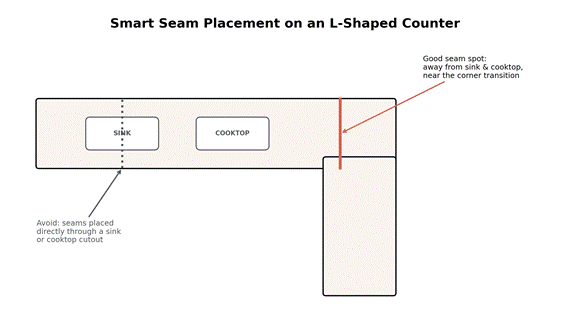
Seam placement is one of the most overlooked parts of the process, and it’s almost entirely determined by the size of the raw slab and the layout of your kitchen. A good contractor plans seams around your sink, cooktop, and high-visibility areas rather than wherever is easiest to cut.
Thoughtful seam placement is a planning decision made well before fabrication begins, not an afterthought during installation.
This is also where experience with local homes helps. San Diego’s mix of older post-and-beam construction and newer builds means cabinet runs and corner angles vary more than people assume, and a contractor who templates and fabricates in-house can adjust seam planning accordingly instead of working from someone else’s measurements. For material-specific guidance once you’ve chosen a contractor, our guides on quartz countertops and quartzite countertops cover what to expect from each material.
Questions Worth Asking Before You Sign
| Question | Why It Matters |
| Do you template and fabricate in-house? | Fewer handoffs means fewer chances for measurement or communication errors |
| Can I see the actual slab before it’s cut? | Natural stone varies piece to piece, seeing it confirms veining and color match your expectations |
| How do you plan seam placement? | Determines how visible seams will be in your finished kitchen |
| Are you licensed for this type of work? | Confirms the business is verifiably qualified to perform the installation |
Ghiloni Granite and Tile has held License #1054873 and been fabricating stone across San Diego County since 2004, handling templating, fabrication, and installation as one continuous, accountable process.
What Happens After Installation
The relationship with your contractor shouldn’t end the moment the slab is set. A proper installation includes a final walkthrough where seams, edges, and overhangs are inspected together with the homeowner, along with guidance on day-to-day care for your specific material. Natural stone and engineered surfaces each have different cleaning recommendations, and a contractor who takes the time to explain them upfront saves homeowners from avoidable mistakes, like using the wrong cleaner on a honed finish or not resealing granite on schedule.
This final step is also a reasonable point to ask about warranty coverage on both materials and workmanship. A contractor confident in their fabrication and installation process will typically stand behind both without hesitation.
Frequently Asked Questions
What’s the difference between a stone fabricator and a countertop contractor?
A stone fabricator cuts, edges, and finishes slabs in-house, then installs them directly. A general contractor may offer countertop installation as part of a broader remodel but often subcontracts the actual stonework to a fabricator, adding a layer between you and the people doing the cutting.
Do I need to be home for the templating appointment?
It’s recommended, since this is your opportunity to discuss edge profiles, overhangs, and any last-minute layout questions directly with the team that will fabricate your slab.
Can I choose the exact slab that will be used for my countertop?
Yes, and you should ask about this upfront. Reputable fabricators will let you view and approve the specific slab, since natural stone varies in veining and color even within the same material category.
What licensing should a San Diego countertop contractor have?
Look for a valid California contractor’s license number, which you can verify through the Contractors State License Board. A legitimate fabricator will list their license number without hesitation.
How involved should I be in seam placement decisions?
As involved as you want to be. A good contractor will walk you through the proposed seam locations before fabrication begins so there are no surprises on installation day.
Ready to Work With a San Diego Countertop Contractor?
Ghiloni Granite and Tile handles templating, fabrication, and installation in-house for kitchens across San Diego County. Explore our services or get in touch to start your project.
Call Ghiloni Granite and Tile today: (619) 261-3595