

A backsplash does more work than most homeowners give it credit for. It protects the wall behind the sink and cooktop, ties the countertop and cabinetry together visually, and it’s one of the few surfaces in a kitchen you look at every single day. When it comes time to install one, the biggest decision isn’t color or pattern, it’s whether to go with a full stone slab or traditional tile, and that choice affects everything from maintenance to how the finished kitchen actually reads.
| QUICK ANSWER A custom backsplash in San Diego generally comes down to two paths: a full-height stone slab that continues straight up from the countertop with zero grout lines, or tile, which offers more pattern flexibility at a range of heights. The right choice depends on how the space is used, how much visual continuity you want with your countertop, and how much grout maintenance you’re willing to take on near the cooktop. |
Slab Backsplash vs. Tile Backsplash
As a stone fabricator first, we get this question often at Ghiloni Granite and Tile: should the backsplash be cut from the same slab as the countertop, or should it be tile? Both are legitimate custom installations, they just solve different problems.
| Factor | Slab Backsplash | Tile Backsplash |
| Grout lines | None, continuous stone surface | Present, requires regular sealing or re-grouting |
| Design continuity | Matches or book-matches the countertop veining | Independent design element, more pattern options |
| Cleaning near the cooktop | Wipe-down, nonporous surfaces resist grease | Grout lines can trap grease without regular care |
| Best for | Homeowners who want a seamless, high-end look | Homeowners who want color, pattern, or texture variety |
The Three Backsplash Height Zones
Before choosing a material, it helps to decide how far up the wall the backsplash should go. This decision changes both the look and the practical coverage, especially in the zone directly behind the cooktop where heat and grease are most concentrated.
Height is often decided by function first: how far up the wall you actually need protection.
Full-height slab backsplashes have become increasingly popular in San Diego kitchen remodels, largely because they eliminate the visual break between countertop and wall entirely. When the same slab is used for both, especially with a bookmatched or continuous vein pattern, the kitchen reads as one continuous surface instead of two separate materials meeting at a seam.
Matching Material Performance to the Cook Zone
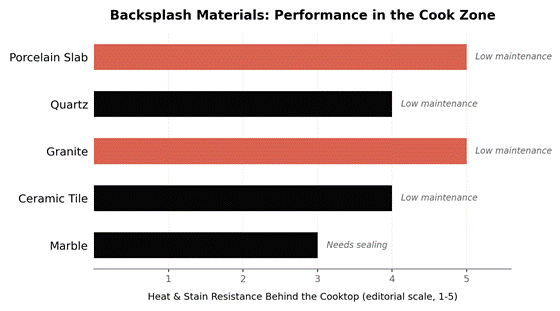
Not every material performs the same way directly behind a cooktop, where heat and grease exposure is highest. This is worth thinking through separately from the rest of the kitchen, since a backsplash that looks great in a photo can perform poorly in the one spot that sees the most daily wear.
An editorial comparison based on how each material has performed in real installations behind a cooktop.
This is also where slab fabrication has an advantage tile can’t always match. A single piece of porcelain, quartz, or granite behind the cooktop means there’s no grout line sitting directly in the splatter zone. If you’re weighing a full kitchen renovation rather than just the backsplash, our granite and tile services page covers the full scope of what we fabricate and install.
Coordinating the Backsplash With Your Countertop
Whether you go with slab or tile, the backsplash should feel intentional next to the countertop, not like an afterthought. A few approaches we see work consistently well:
| Approach | What It Looks Like |
| Continuous slab | Countertop and backsplash cut from the same piece of stone for uninterrupted veining |
| Complementary tile | Tile in a tone that echoes the countertop’s undertone without matching it exactly |
| Contrast accent | A deliberately different material used as a focal point, often behind a range only |
If you’re still exploring layout and pattern options more broadly, our earlier guide on tile installation patterns and layouts is a good next stop once you’ve settled on slab vs. tile for your specific backsplash.
Grout and Sealing: What Ongoing Care Actually Looks Like
Whichever direction you choose, it helps to know what you’re signing up for after installation day. Tile backsplashes rely on grout lines to stay watertight, and while modern grout formulations resist staining far better than they used to, the lines still benefit from an occasional sealant refresh, especially in high-splash zones near the sink and cooktop. Slab backsplashes skip this step entirely since there’s no grout to maintain, though porous natural stones like granite and marble still benefit from periodic sealing to preserve their stain resistance over time.
This is one more reason the material conversation and the height conversation tend to happen together. A full-height slab behind a cooktop all but eliminates ongoing maintenance in the zone that needs it most, while a standard 4-inch tile splash in a lower-traffic area is a reasonable trade-off if the design calls for it.
Frequently Asked Questions
Does a slab backsplash need to match the countertop exactly?
Not necessarily. Many homeowners choose to continue the exact same slab for a seamless look, but pairing a complementary stone or solid-surface material is also common, especially when the countertop has a bold pattern that could be overwhelming at full wall height.
Is tile easier to repair than a stone slab?
Individual tiles can sometimes be replaced if damaged, while a stone slab typically requires a professional repair or, in rare cases, replacement of the affected section. Both are durable when installed correctly, damage of either kind is uncommon.
Can I install a full-height slab backsplash only behind the cooktop?
Yes, this is a common approach that gives you the seamless, low-maintenance benefit of slab exactly where it matters most, while using tile or paint for the rest of the wall.
How do I know if my wall needs full-height coverage?
If the wall gets regular grease or moisture exposure, such as behind a cooktop or a prep sink, full or mid-height coverage is worth the investment. Walls that only see occasional splashes can often work with a standard 4-inch splash.
Do custom backsplashes require a permit in San Diego?
Standard backsplash installation typically does not require a permit since it doesn’t involve structural or plumbing changes. If your project includes moving electrical outlets or plumbing fixtures, that portion may require a permit.
Ready to Design Your Custom Backsplash?
Ghiloni Granite and Tile has been fabricating and installing custom stone surfaces across San Diego County since 2004. Explore our services or get in touch to talk through slab and tile options for your kitchen.
Call Ghiloni Granite and Tile today: (619) 261-3595